
 Good equipment makes snowshoeing far more enjoyable, but you don’t need to buy an expedition wardrobe for a winter hike in the Alps.
The key is to stay warm without overheating, keep your feet dry and carry enough to deal comfortably with changing conditions. In the mountains, sunshine, wind and temperature can change quickly, so a flexible layering system matters much more than one enormous winter jacket.
Here’s what we recommend for a guided snowshoeing day or multi-day winter trip.
Dress in layers
Several thinner layers work better than one very thick layer. You warm up quickly on an ascent, and being able to remove a layer before you start sweating helps you stay comfortable when you stop.
Start with a breathable base layer. Add an insulating mid-layer such as fleece or wool, and carry a warmer insulating layer for breaks. Your outer layer should protect you from wind and snow.
Try to avoid cotton next to the skin. Once wet, it stays wet and can make you cold.
Choose the right boots
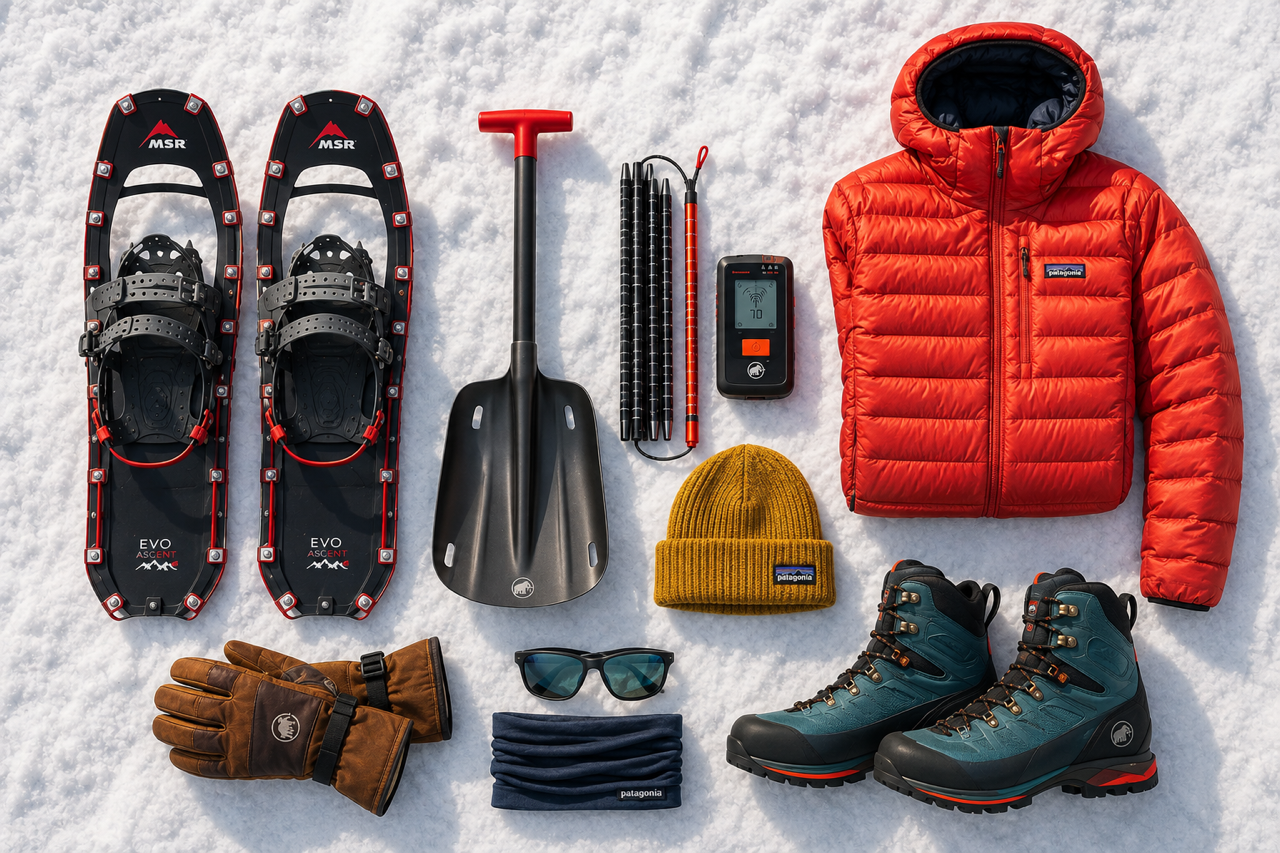
Sturdy, waterproof, high hiking boots are one of the most important pieces of equipment. They should be warm enough for winter conditions and work comfortably with snowshoes.
Warm hiking socks are important too, but very thick socks are not automatically better if they make your boots tight and restrict circulation.
If you’re joining a multi-day trip, make sure your boots are already broken in. A winter adventure is not the place to discover that a new pair rubs your heel.
Keep your hands, head and eyes protected
Bring warm gloves and ideally a spare pair. A hat or warm headband is useful, as is a buff or neck warmer.
Winter sun can be surprisingly intense, particularly when it is reflected by snow. Sunglasses with good UV protection are essential; goggles can be useful in wind or snowfall.
Sunscreen and lip protection belong in your backpack even on cold days.
Do I need to buy snowshoes and poles?
No. Snowshoes and poles can be rented through us, so there is no need to buy specialist equipment if you are trying snowshoeing for the first time.
If you already own suitable snowshoes and poles, you are of course welcome to bring them.
When do I need avalanche safety equipment?
Avalanche safety equipment – a transceiver, shovel and probe – is required on our Bernese Oberland and Italian Alps multi-day trips and on some day trips around Verbier, depending on the terrain and conditions.
It is not normally required on the Jura trip.
Avalanche equipment can be rented through us. Where it is required, your International Mountain Leader will explain how to use it before setting out. You do not need previous experience with avalanche equipment.
What should I carry on a day trip?
For a typical snowshoeing day, your backpack should contain water, food or snacks, spare warm clothing, spare gloves, sun protection and any personal medication you need. Depending on the route, you may also carry avalanche safety equipment.
A small thermos with a warm drink is optional, but on a cold winter day it can be one of the nicest things in your backpack.
Your Mountain Leader will let you know if anything additional is required for your particular route.
Avalanche safety equipment is only required on trips where the terrain and conditions call for it. You’ll always be told in advance exactly what equipment you need for your specific trip.
What changes on a multi-day winter trip?
On our multi-day winter trips there are no luggage transfers. You carry the personal belongings you need overnight.
That makes disciplined packing important. Take what you need, rather than everything you might conceivably use. You will receive a detailed trip-specific packing list before departure.
The exact list varies slightly between trips because the accommodation is different. A simple stay in the Jura requires a different approach from a hotel-based itinerary in the Bernese Oberland.
How do I avoid getting too cold – or too hot?
One of the most common beginner mistakes is actually wearing too much while walking.
Snowshoeing can be surprisingly warm work, particularly uphill. If you wait until you are sweating heavily before removing a layer, that moisture can make you cold later.
Take a layer off before you overheat and put a warm layer back on as soon as you stop. Your Mountain Leader will happily remind the group to adjust clothing during the day.
Staying comfortable is not a test of toughness. It is part of sensible winter travel.
Do I need to buy everything before my first trip?
Definitely not.
If this is your first snowshoe trip, there’s no need to buy specialist equipment. Snowshoes, poles, backpacks and avalanche safety equipment can all be rented directly from us. Invest first in the things you can use for many mountain activities: good waterproof hiking boots and a sensible layering system. Snowshoes, poles and, where required, avalanche safety equipment can be rented through us.
After booking, you’ll receive a detailed packing list for your specific trip, so you know exactly what you need – and what you can leave at home.
Gear List for a Snowshoe Outing
❄️ Waterproof hiking boots with good ankle support
❄️ Waterproof or softshell lightweight jacket
❄️ Insulating layer – a light down/synthetic jacket or fleece
❄️ Extra T-shirt or long-sleeved base layer (synthetic or wool)
❄️ Warm hat and buff or scarf
❄️ Gloves – preferably waterproof, with thin liner gloves
❄️ Sunglasses (and spare glasses/contact lenses if needed)
❄️ Sunscreen (SPF 30+)
❄️ Personal medication you may need during the day
❄️ Comfortable backpack (max. 30L), preferably with external straps to attach your snowshoes
❄️ Snacks or a picnic lunch if we are not stopping at a restaurant
❄️ Minimum 1 litre of water
.
Available to Rent
❄️ Snowshoes
❄️ Hiking/ski poles
❄️ Backpack (max. 30L)
❄️ Avalanche safety equipment (transceiver, probe & shovel)